neděle 15. dubna 2012

How we did a winter traverse of the Vrancea Mountains.-continuation of the story


Day the 3rd- Toward the untamed heart of the Vrancea Mountains.

 
Stanele din goru at dawn.

The sleep was relaxed with no cold coming from the ground below us. Resting on wooden bed is the best option in winter conditions!
There was no hurry to wake up early for sunrise pictures. We got up at an easy 7:30 am time. To get ready for taking pictures required only putting boots and gaiters on and stepping outside. The temperature was low, while there was no wind and skies were clear. We repeated last evening scenario in the opposite order. Dawn pictures taken at first, sunrise pictures completed in the second row. 
                             Looking south-west from Stanele din Goru at dawn.
                                                                         Goru at dawn.

                                                                           Goru at dawn.
  
                                          Looking south-east from Stanele din Goru before sunrise.
                                                              At dawn at Stanele din Goru.
                                                         Stanele din Goru at sunrise.
                                                     Breakfast time at Stanele din Goru.

 Just when we were about to depart, a veil of mist approached from the north. We could see that above us was a clear sky and considered climbing to Goru Peak (1786 m), which is the tallest peak in the whole Vrancea Mountains. Knowing that we would lost a lot of time in deep snows, we opted to get as quickly as possible to Giurgiu peak, also higher than 1700 m. From that mountain we could see the scenery from a different angle of view, its sits just opposite to the Goru Peak. On the map it did not appeared too far away, and when viewed from the Lacauţi Peak it seemed to be close to Goru Peak.
                                        Arrows pointing in direction for Goru, Paraul Goru and Lacauti.

                                                                    Fog alternated with sun.

                                                                 Old forest below Goru.


                                                      Our traces on virgin snow below Goru.

                                                      It was difficult to chose the corect path.
                                                        Locating our position on our map.
                                                                     Taking the wrong way.


We bypassed an intersection with indicators showing directions to Goru Peak and to Pârâul Gorului. However this was a trail for somewhere in the summer. I can’t wait to get there in next summer! From here on we would be exploring on a terrain unfamiliar to us. Despite the fact that we had a map, it was difficult to steer through deep forests. Basically we had to remain on the crest, leading to south-east from the Goru Peak. On the road in front of us were pure snows. Our footprints were the only ones left on its white flawless surface. At first the road was leading in good direction, and later it turned southward. This was not good, we needed to keep in south-east direction. We deserted the road and kept on the ridge. There was a road, but we only discovered that the road descends to the north side to Zăbala River Valley. After descending a third of a kilometer we realized that we were heading in wrong direction and returned back to the crest. We were enveloped with fog, through which sun was shining at some spots. We walked through beautiful parts until we hit the road again. It was the same road, we abandoned less then an hour ago.
                                                        Searching for a correct path in the mist.

                                                           Going on trailless but beautiful section.
                                                         The forest road was a correct path.

The animal footprints showing that it turned around and returned on its own track (it probably was a weasel).
                                                                                  Forest decor.
                                                                Brown bear's track across the forest road.

                                                 Brown bear's track disappeared in the forest.

With new joy we continued down on the road. It led more to east-south-south direction than it was supposed to lead. On one spot we crossed paths with brown bear’s track. Later we stopped on sunlit corner to take a warm sip. The tea was so hot, that we needed to put snow inside to cool it a little. In this way we obtained more liquids. We suspected that we were on the wrong path, because to direction was almost towards south by now. Plus the road was descending. We guessed that the road must lead to Bâsca Mică Valley bottom. It was better to abandon the road here in favor for unclear trail leading east. This path led us through young coniferous forest covered with snow. On two spots we discovered tracks and dropings of a capercaillie, inhabitant of coniferous forest. The path turned almost in north direction and was overgrowned with trees on many places. Finaly we declined for going without a trail more to the left. Steep climb through old-growth forest brought us to the same road which we abandoned an hour ago. On the road there we saw our own prints, folowing them until we met with those bear’s prints. Climbing back to the top we tried to decide what to do next. Our priority was to go to east diretion, so Ioan went there to explore if there was any trail heading east. Out of blue, he called out the thick grove, that there is a road heading-eastward. The entrance was obscured by low hanging branches, clothed in white. The trail led in our dirrection, descending.
In thick forests I discovered a scrathed tree. At the height over one and a half of meter I found thin long curly tanned hair. At least this must be brown bear’s hair. The tree was used by the bear for demarking its territory. I took a hair sample and put it into a clear plactic bag. At home I wanted to show it to some people for correct determination. But this was not to be. I lost the sample somewhere farther into the trip. The trail descended abruptly and we got to a saddle in between two forested peaks. There was a clearing and we stopped there for a lunch. It was 1 o’clock pm. It was quite warm on the sun and snow started to be wet on sun-exposed areas. It was a sign that temperatures were rising.
                                                                     Bear's tree in wild forest.

                                   Going down into a saddle where we had a lunch. Our trail continued on those                                                    hills on the other side of the saddle.

                                                              Looking back, from where we came.

The climb from the saddle was steep, almost without a trail. Once we got to the top, we could se nothing but a solid forest. Map and a compass were the only tools to keep us on the right tracks. Ioan repeatedly checked his compass to keep us heading east. There were no features in the lanscape, only steep forested slopes, with no clue leading to the crest.
After another hour had passed, the terrain became nearly level. There was not anything to be seen around us, but a closed woodland. Crossing bear’s track for the third time today we thought that it is good that we made no direct encounter with a large carnivore. It was clear that wildlife has very sharp hear and it maintains safety distance of any possibly dangerous human being. In this part we walked separated by a distance of about 50 m, Ioan intentionally stopped and stood still, just listening. Then he said, that the noise of my steps would scare any wildlife away before we had a chance to spot it.
                                                                     Brown bear again!


Right here we decided to make a spin to the left and continue toward the east. If we kept going in the direction we were heading in the last stretch (ridge led to the south) we would arrive at the Giurgiu Peak by the nightfall. After ten minutes we entered in a mountain meadow. Our difficulty with the map-reading was that we overvalued the distance covered by us. We basically walked lesser distance, then we thought, in those profound snows. Having had no point of reference we simply hadn’t knew that the Giurgiu Peak was so close in front of us. 
                                                                         Emerging on a meadow.

                                                                 All was silent and beautifull.

                                         In deep snows on the high meadow below Giurgiu Peak.


                                                           Following a water course for a while.
                                                     Big high meadow below Giurgiu Peak.

 There was a watercourse descending all the way through the meadow and we followed its line, until we got to the forest margin. Besides there was a rim of a side vale, leading to the main basin of the Zăbala River. Slopes were abrupt, that was why we opted to set off on the edge, which proved to be a lesser ridge named Culmea Prelunca, leading somewhere to the vicinity of Caldarile Zăbalei zone, at least we contemplated  it. In fact the ridge descended to the place called Cabanele Giurgiu.
To our delight there was a good trail on the crest, simple to follow, with nearly no snow cover on it. The path was also used by a lonely capercaillie ahead of us, and we followed its track for a kilometer or somewhat like this. At the junction we took left, in the direction of north, anxious that following the trail to the east we would appear excessively faraway from Cabanele Giurgiu. The trail led us downward all the way through northern slope, with almost no snow cover. What a discrepancy, on not distant meadow right above us, there was a bunch of snow, but here deep woods did not permitted snow to drop on the soil. In less then an hour later we were in the bottom of the side valley. The way was icy, but easy to follow. We noticed an ideal asylum made by forest staff, where would be comfortable to spent night time. It was still early, so we gambled on discovery of a further shelter at Cabanele Giurgiu.
After getting into the main valley with flat bottom, we walked briskly to our destination of the day. There were no bridges in the valley. They were not added, because trucks carrying logs have no need for them, instead of bridges there were numerous fords. We needed to wade in the water at least for three times. Luckily the water level was much lower then it was in summer and we had no problem other, than wetting our boots a little more. They were already damp from walking in wet snow during the day.
                                                          Flat bottom of the Zabala river valley.

                                                                        Zabala River in winter.

Arriving at Cabanele Giurghiu at dark we promptly explore the area with several buildings. One of them was not locked and had several rooms inside it, equipped with beds and wood stove. Rooms were cozy enough to encourage us to sleep in safety, within four walls.
                                                               Indicator showing direction.

                                                                        Inside the building.

We put off our rucksacks from tired shoulders and went out to bring water. This time we had running water in the river and did not need to melt snow. The evening felt very comfortable, even though the room temperature was probably sub zero. Outside it was freezing much more. The temperature outside would drop at about  -10°C by the morning.
The night was much more pleasant than previous two nights. Because there was nothing to photograph, since we were at the bottom of the valley, we enjoyed the calm of the long winter evening without doing any work other then preparing hot drinks and food. Later we had time to talk more about ouf feelings. I felt very comfortable to make a connection with Ioan’s family. It was surprising for him to hear my explanation, that before we two met on last Christmas in the Nemira Range, I made no close connection with anybody in Romania. Even though I was visiting here regularly since 1996. I explained that my trips were focused on crossing main ridges in the mountains, discovering natural wonders in the Apuseni Mountains and with almost no contacts with locals, except meeting with an occasional shepherd, village elder etc. When I descended from a mountain, I aboarded on the train or a bus and went home. Plus when I was travelling with other czech people, we were like a closed circle, making no serious connections with anyone outside that bubble. Last Christmas made the difference and since this time, not one of my current romanian trips was like it used to be before. There was only a single exception. In 1999 I met with a girl, called Andreea. She was from Mediaş and we met in Cheile Râmetului, in the Apuseni Mountains. We kept in touch for a year or something, but never reunited. I lost a contact with her. I think she must be married by this time, having a family. Who knows.

Day the 4th-Double topping-climbing Pietrosul and Zboina Frumoasa peaks in a single day.

                                                              Leaving the Zabala river valley at dawn.

We woke up early, well before sunrise. On that day we wanted to climb Pietrosu Peak, towering right above us. The tourist indicator standing just outside the cottage showed a distance od 5 hour to get to the peak. This information was exagerated we thought.  Actually the peak was less then three hours away. The distance to the village of Vetreşti-Herăstrău, where we wanted to get today was indicated as 8 hours of walking.
At the beggining I did a stupid thing of refilling my gasoline heater. I kept gasoline stored in a clear PET bottle in duration of the trip. I grabbed a bottle from the table a put the liquid into the heater tank. After giving 50 strokes on the pump, I turned on the regulator and tried to light the burner. To no avail. Gas was running out but it wasn’t burning. What went wrong? A while later, after several futile attempts to lit the heater, I discovered that I used a bottle with water to refill the tank. I mistakenly grabbed a bottle, filled with water from the river, instead a bottle with gasoline! Well, then. I tried to get water out and replace it with new gasoline. It didn’t work, due to a costruction of the Coleman Peak 1 stove, the content of the tank can not be extracted without removing the burner. This I was afraid to do, because of the damage on the generator needle I did on the very first evening.  In that way I remained without important part of the equipment. Beiing without a stove in winter is more serious then in summer, when there is a lot of running water.
We prepared breakfast on Ioan’s gas stove and set off at day break. The sky was clear and the air was still in the valley. It was freezing, but we warmed up when climbing toward a mountain pasture called Golul Pietrosului. The meadow sits in a wide saddle in betwen Pietrosu and Zboina Frumoasa.


                                                           Climbing toward Golul Pietrosului.

                                                   Solitary beech tree below Golul Pietrosului.

                                     Sunrise at Golul Pietrosului. Zboina Frumoasa in backdrop.
                                               Looking toward Goru from Golul Pietrosului.

                                                                       A way to Pietrosu Peak.

                                                                 Ioan at Golul Pietrosului.
                                                        Beech tree on fire at Golul Pietrosului.

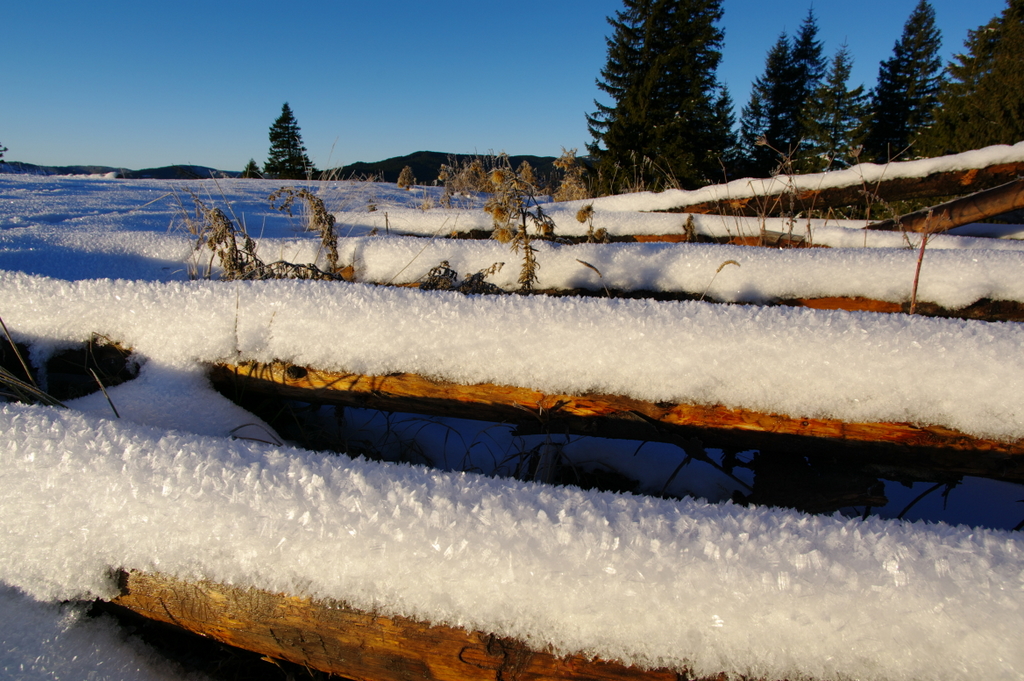
                                                Frosty snow on logs at Golul Pietrosului.

                                                    Winter decoration at Golul Pietrosului.

Reaching the saddle at sunrise we took photographs first. The saddle was windy and suddenly we felt cold. Later, when the finest colours were gone, we decide what to do next. We realized that if we made an attempt on Pietrosu we would not make it to Vetreşti-Herăstrău by daylight. The better option was to prolong our stay in the mountains by one more night. In that case we would get to Zboina Frumoasa and Lapus Mare peaks. In addition from there it will be much storter distance to get back to civilisation. Since I was eager to stay longer in the Vrancea Mountains and getting to Zboina Frumoasa was on my wish list for more then two decades by now, there was no leeway I would say no to such an offer!

                                                             Thick forest below Pietrosul Peak.
 Hidding our rucksacks under a tree we set off for the summit. We were already at altitude of over 1300 m, so the peak was not far away. We were just a little afraid of the safety of the food, since there were bear’s footprints in the snow on a nearby forest road. Higher on the ridge we entered very thick forest, through which walking was quite labourious. Nevertheless we made it. Later we found a track of a capercaillie and a bear.  At the first peak we stopped for a while. The views over the Vrancea were incredible. 
                                                                      Reaching the ridge.

                                                          "Group" photo below Pietrosul.
                                                                      Brown bear again!
                                                            "Self-portrait" below Pietrosul.


                                                                       Capercaillie prints.


                                                           Mount Coza seen from Pietrosul.

                                                           Ioan taking pictures on Pietrosul.

                                         Looking at Izvoarele Narujei from Pietrosul. Nemira Range in backdrop.
Bucegi and Fagaras seen from Pietrosul. Our yesterday's track is also visible. Giurghiu is on the left margin. Just folow the front forested ridge from right to the left.
                                                                             Penteleu ridge.

Later we walked on the crest, until we reached the terminus point. From there view opened toward the north. In this part we clearly saw the Nemira range, Golul Cozei, Izvoarele Narujej, and Dealul Negru. On the west we saw Penteleu, Goru, Bucegi Mts., Făgăraş Mts. On the south just opposite us were Zboina Frumoasa and...sea of clouds. On the east there was Magura Odobeşti and again a sea of clouds. We were overlooking almost the whole Vrancea Mountains.The description of the Vrancea Mountains I saw for the first time in 1988 red: “Even far away Zboina, Coza, and Furu make a part of the Vrancea Mountains.” (“Chiar si departatele Zboina, Coza, si Furul fac parte din muntii Vrancei.”) The descripton was related to a view from the Goru Peak, but it also fitted to a watch from Pietrosu Peak. Back in 1988 it did not occur to me that it would take me more then 20 years to see it with my own eyes. The citation comes from a book “Carpathian Games” by a well know czech author who spent a quater of century exploring mountains of Romania in between early 1960s and late 1980s. The book was also in print in Romania by a publisher named Tribuna, Cluj in 2007.


                                         Giurgiu Peak was opposite us. In backdrop is Bucegi Mountains.

                                                     Ioan taking pictures atop Pietrosul.
                                                 Cabanele Giurgiu seen from Pietrosul.


                          Magura Odobesti, an important landmark on the east side of the Vrancea Mountains. A view toward Herastrau.
                                         Mount Coza, Mount Cristianu, Saua Geamana seen from Pietrosul peak.

I told Ioan that  here in the mountains of Romania, the valleys are so big that a whole czech mountain masiff would fit into a single valley in the Vrancea Mountains. Such an impression had a view over the range from the Pietrosu Peak.
                                               Zboina Frumoasa seen from Pietrosul Peak.

 The descend was uneventfull. We picked up our backpacks from under a tree. They were untouched. I must say that we saw no people in the Vrancea Mountains, with a an exclusion of a forest worker at Bâsca Mare River valley and a meteorolog atop Lacauţi Peak.
                                                               Beech trees on Golul Pietrosului.
                                      Beech forest in Romania looks differently than in my country.
                                               Searching for a correct path in dark woods.
                                                               Marked trail found!
 
 Walking on Golul Pietrosului, enjoying the views of the mountains, nothing left to be wished. Our rucksacks were much lighter by now, easier to carry. We had some problems to navigate our way to the meadow under Zboina Frumoasa. There was a maze of old forest roads and it was dificult to decide which route to take next. We checked photographs taken high on Pietrosul, which helped us a little. Here for the first time we met with beech forest. The central part of the Vrancea is covered in continuous coniferous woodland. Only on east and west there are beech forests.
                                                    Big meadow below Zboina Frumoasa.

                                                                 Walking toward the sun.

                                                                    At rest at sunlit meadow.

                             Wooden box for shepherds used for sleeping close to animals in summer season.

                                                  High meadow below Zboina Frumoasa.

                                                                    We come from the sun.

                                                     Finding bear's track below Zboina Frumoasa.

Later we get onto a forested ridge, where we reunited with tourist marking. Marks were old, however the trail was obvious. Arriving at the meadow brought a big relief to us. There we rested on the sun for a while, sitting on a patch of dry winter grass. The meadow was snowed in and and on its margin there was a sheepfold. It would be nice to spent a night here. After renewing our body energy with a chocolate we continued toward Zboina Frumoasa. Since there was only tall forest atop, we did not plan to climb there. The marked path makes a detour a meets with another marking coming from the east. Here we reunited with the trail which Ioan took on last Easters. I remembered it from reading his article. This time we will be walking in opposite direction. Zboina Frumoasa is over 1600 m high and the decend to Lapoşul Mare was about 400 m. It went through dark forests, mainly on a forest road system, linking village of Nereju with Zboina Frumoasa. 
                                                                             They were old.

                                              Yet another bear's track below Zboina Frumoasa.

                                                                 Wild forest below Zboina Frumoasa.
                                                                        Looking toward Furu.

                                                                Sunset behind Penteleu.
                                                     Evening in the Vrancea Mountains.
                                                        A walk toward Laposul Mare.
                                                   Twilight wedge above Magura Odobesti.
                                                             Sheepfolds at Laposul Mare area.
                                                                              After sunset.
                           If you want to make pictures after sunset don't forget to bring your tripod. 
                                                                             By the fire at night.

                                                                           Inside our shelter.


We got to Lapoşul Mare past sunset. At the forest margin we spoted a woden box, with two benches inside and a table. It was new and used by forest stuff as a resting place. There was a writting above the entrance oppening, saying:  “Place for smoking and taking a rest.” The box was inviting to spend a night here. Just beside there were two dead trees, which could serve as a fuel source. We needed to build a fire in order to thaw snow for water.
First we took off a little farther to explore a different refuge. The building was much larger and it was clean inside. But outside there was a slight breeze, which was powerfull enough to chill us, if we would stand next to the fire outside. I talked Ioan into returning to the first building.
With ease we build a fire just next to our “hotel.” Melting snow on a fire was a joy, because of the heat coming from it.  We only had to be carefful not to burn our hands or equipment in the fire.
This time we could have as much hot tea as we wished, since we had no limits on firewood. The source would endure for several evenings. The tea had a smoked taste, quite a difference form a tea prepared on the stove. One must get to be acustomed to it and for a first timer this fact can be little surprising. Since there were no doors at the entrance, we put a plastic cover over the openning. At night we laid on wooden benches, feeling perfectly warm.

Day the 5th-A long way to civilisation.

The morning dawned clear and cold. Because of our wet boots, which felt uncomfortable to wear, we did not rush for early morning photos. I suspect, that if we had dry and warm boots we got up a little earlier and wentured farther out. We opted just for a couple of shots taken from nearby the door. 
                                                                        Before sunrise.

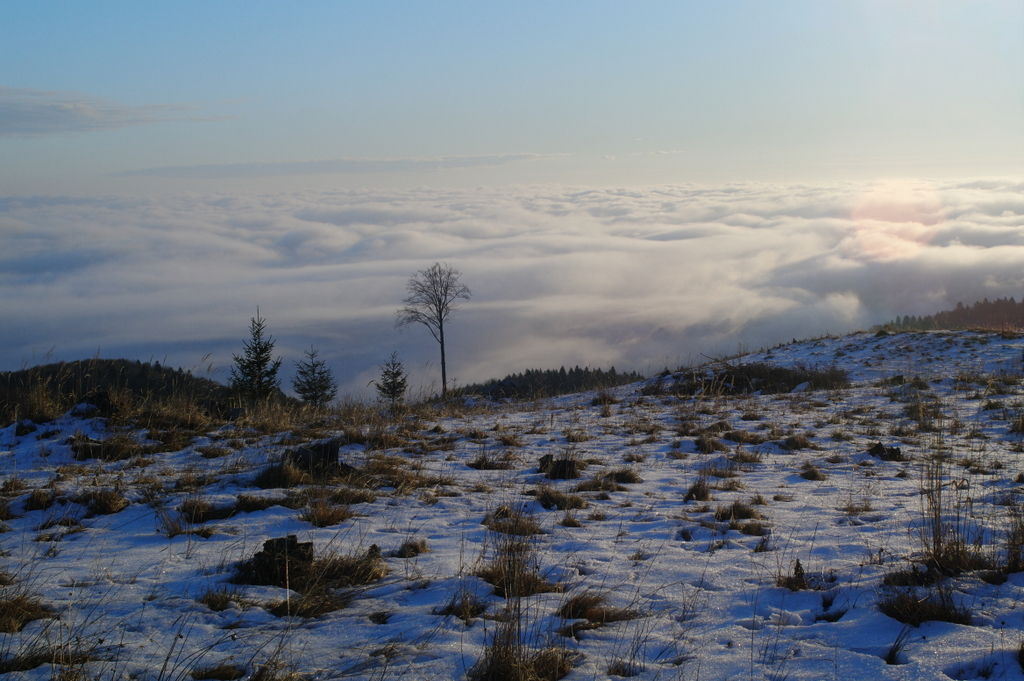
                                                       Another perfect morning in the mountains.

We used Ioan’s stove to rewarm a tea prepared yesterday, ate a little from our provisions and set off for the finall stretch of the journey. We supposed it would take us three hours to get to the nearest village, which we supossed it should be Vetreşti-Herastrau. If we wanted to descent to Nereju village it would be even faster. But somehow we wanted to get to Herastrau. Ioan told me that there lives his friend, whom he met in last summer during the remarking action. If we arrive soon enough in the valley we could meet with her.
From Lapoşul Mare we continued in the north-east direction on the subsidiary ridge. At first the road was easy to follow. Below us was a sea of clouds. Later we get at he margin of the clouds, which had a great potential for taking photographs with sun and fog at the same time. So we used remaining energy in our camera batteries there.
                                                              Looking into foggy vale.

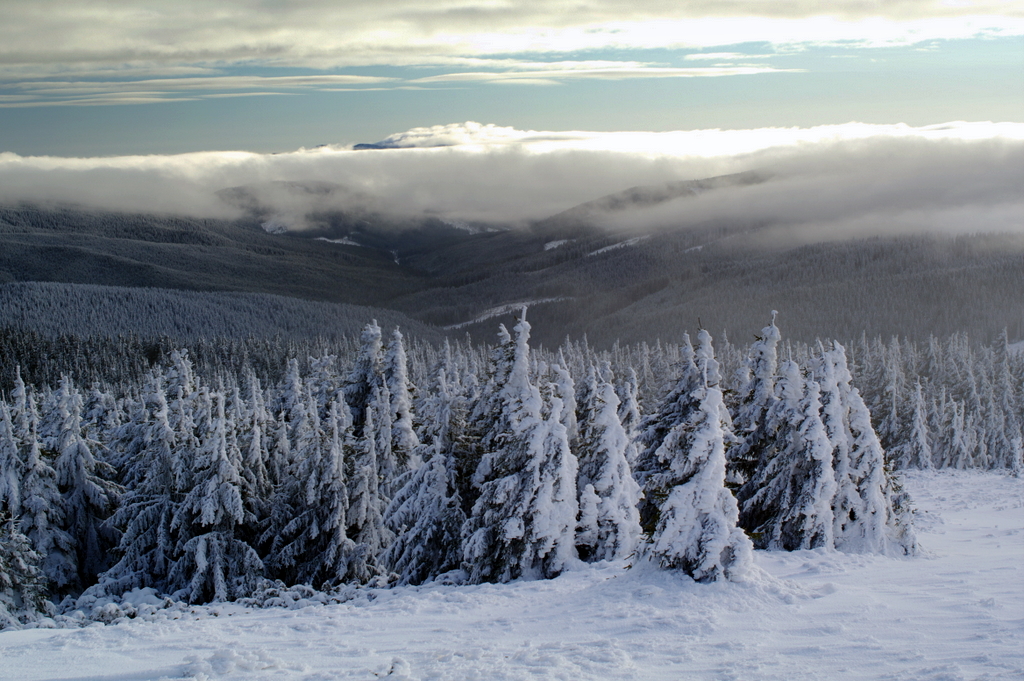
                                                                         Still above the clouds.
                                                                      At a margin of clouds.

                                                              Capturing the magical moment.
                                                              Heading down, leaving pastures behind us.
                                                        Wild beech forest at the last leg of the trip.

At one place the road split. It was difficult to take a decision. We thought it would be better to keep to the north instead of east. So we kept always in north direction. At some places we went on roadless part. Nevertheless we descended and that was what we neded to do. The descent was steep and finaly we emerged inside a large white valley.
Because it was foggy, we could not see much what was around us. Soon we hit the road and chose to follow it to the left. A while later it seemed to be taking a big detour to the left and we prefered going straight on, so we abandoned the road and descended through the forest. At first it was easy, walking in a beautifull and surprisingly wild beech forest. Then the valley narrowed and become a canyon. The best option was to climb on the opposite side, where we got onto a narow edge, terminating with abrupt slopes on three sides. From there we saw first cottages. The slide down was quite difficult, although we managed it safely, crossed the brook and emerged on a sunlit meadow. There was no snow on the ground, we have left winter behind us in the mountains. 
                                                              First view of human setlements. 

                                  We got there, leaving the mountains behind us.

We heard some noise and soon we met with locals, who walked beside a horse-powered cart, loaded with hay. Ioan chatted with them for a while and asked them what year was, explaining that we lost traces of dates when being up there in the mountains.
                                       Meeting with locals. Ioan jokingly asked them what year was.
 
Following a narow path we crossed a rivulet on wooden bridge and climbed on steep muddy road toward first houses seen at the margin of the valley. This view reminded me himalayan village, its mudy road, wooden houses no sight of power lines. When we got among houses, it proved to be more modern one, being not like those remote villages in the Himalaya, off course.
                                        A Himalayan scene in the Vrancea Mountains.
                                              Climbing still "Himalaya looking" road.
                                                        Later streets gained european look.
                                                A bridge across the river, village Vetresti-Herastrau.
                                                A group photo at a bus stop in Vetresti-Herastrau.
 We quickly discovered that there was a bus leaving at 1 pm. Now it was 12 o’clock. We visited a local store to buy something to drink and eat. I was asked by locals whether we saw a wolf. I answered no, but said that we crossed bear’s track several times. Those men laughed at this, arguing then bear is not dangerous to man, only wolf is dangerous. Myself I don’t think that either animal is dangerous. It depend on our attitude and behaviour, when we are in the mountains. I know that fear of large carnivores is universal throughout the world. But here in Romania, large carnivores seemed to have more acceptance than in my own country, where they had been exterminated in late 19. century. They are  slowly returning to our territory since 1970s, but the prospects of their future are uncertain, because of urban over-development in our parts. Mountains in Romania are much bigger, thus ensuring that with a certain respect for wildlife from man, big mammals will survive to the next century.
We aboarded a bus and at 1 pm it departed from the mountains. Unfortunately, we did not make it to meet with Ioan’s friend in Herastrau. She lived in other part of the village, some 6 km away from the point, where we descended from mountains.
We changed busses at Focşani and arrived at Bucharest past 5 pm. We still had a time to visit an exhibition in Cercul Militar hall, where Ioan’s father and Ioan himself held and exhibiion of paintings and photographs, respectively. There I met with his parents. Then we visited his aunt place, where we met with his sisters, Irina and Maria. We learned that Maria is leaving to the Vrancea Mountains on the very next morning. They had planned to spent a New year’s eve at a sheepfold on Mount Coza. I was a little disappointed, not to be able to join. But our trip in the Vrancea Mountains was an adventure at its fullest, so I was perfectly satisfied with it, having had no desire to go anywhere.
                                                     An exhibition at Cercul Militar, Bucharest.
                                                     Me at the exhibition in Bucharest.
                                                             Meeting with girls in Bucharest.

Day the 6th-A Rest day
On the next day we moved to Breaza for the final evening. The evening itself was uneventfull, even if it was the last day of the year 2011. We dinned, watched a movie and then went to sleep well before midnight as if it was an ordinary night.
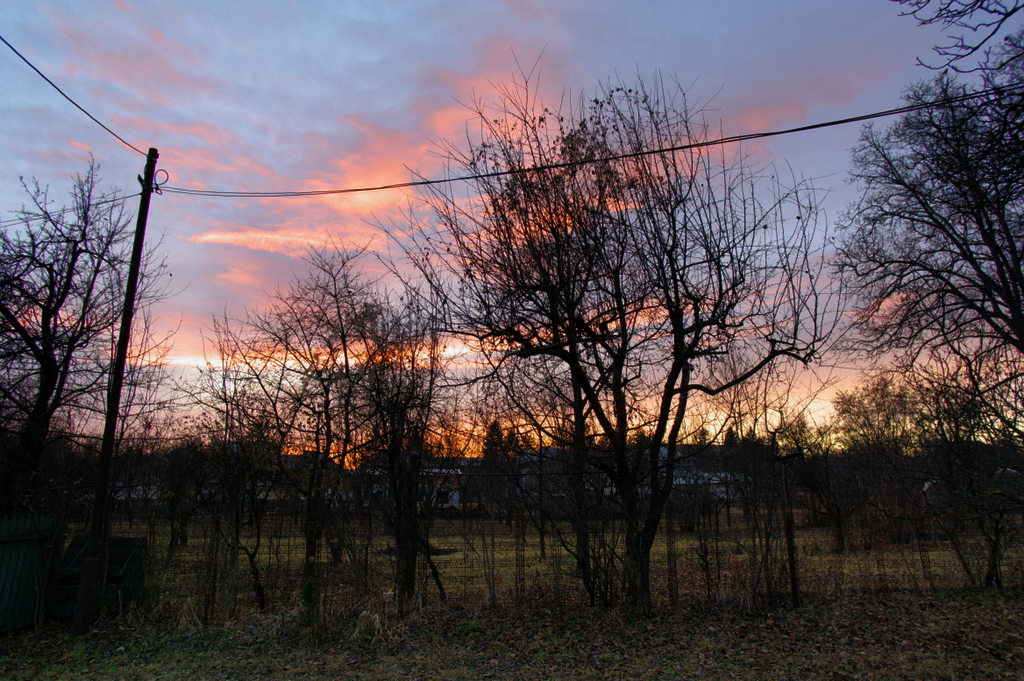
                                                     Sunset on the 31st of December, Breaza.

Day the 7th-Journey home


                                                                     Town's Hall in Brasov.


Next morning we woke up early and set off to catch our trains. Ioan was headed to Slanic Prahova and I went to Braşov. Having arrived there I still had 5 hour left, so I deposited my backpack at a railway station and set off to see city’s center in it’s winter coat. I climbed the Tâmpa peak above the city’s center for an overview of the area. I knew no one in Braşov, so I spent those final hours alone.

            On Piata Sfatului in the centre of Brasov. Tampa Peak in backdrop. I climbed it via "Drumul             Serpentinelor." This trail leads in serpentines just below the cable way line.


                                       Natural preserve Tampa. In spring orchids occur in its forests.
                                                        Cable way climbing up the Tampa.
                                                         Brasov depression seen from atop Tampa.
                                                         An animal rarely seen in Brasov.
                                                           The Black Church seen from Tampa.
                                                     Town's Hall at Piata Sfatului seen from Tampa.
                                                               Stadium seen from high on Tampa.


On the next morning I arrived at home. I felt very relaxed with the trip, thinking that it was a real adventure. The echo of the event was alive for next several weeks after my return home, thus inspiring my ordinary days at a city for future adventures in romanian mountains. 

The End

sobota 14. dubna 2012

How we did a winter traverse of the Vrancea Mountains.


In the beginning I wanted to name this narrative “Getting into the cold air”, because it was a winter trip, made in between Christmas and New Year. We experienced temperatures at a range starting at  – 9°C to – 3°C.  When I got back home a friend of mine asked me how was it there on the trip. I gave her the answer that it was a beautiful excursion, however a little cold.
Actually we experienced not too heavy winter conditions in the Vrancea Mountains. There were mild temperatures and less snow than usual, at least for this time of the year. We did not need any snowshoes or skis, and I had no need for my warmer, second pair of gloves, which I carried on my pack in the duration of the trip. Our last joint winter trip to the Nemira Mountains was far colder. Three weeks after we returned home, the central and Eastern Europe swept a wave of really chill air coming from north-east. Before a cell of high pressure air, causing that cold weather period, stabilized itself north of the Czech Republic, we experienced a heavy snowfall in central and eastern Europe mountains. In the Vrancea Mountains had fallen a lot snow, burying whole cities and villages under profound layer of that cold thing.
Our plan was to traverse the Vrancea Mountains from the west to the east, exactly in reverse direction than we did in last august. As I said before, in this way there is a lot more diversity in the landscape than in north-south or vice versa traverse. The Vrancea Mountains are formed of many isolated ridges, with long intervening valleys, and a single journey never brings you to all important places. We always chat about a future trip there.
To be able to go to the Vrancea Mountains more than a single time, you need to fall in love with them. Afterwards you can feel a desire to be together with those mountains. This noun (mountains), belongs to the feminine gender, and there is no doubt that we both fell in love with them. Although the Vrancea Mountains are not undressed, almost naked, likewise a fashion model. Its beauty is more inner one rather than external one; simply said, it is not exposed for everyone to see. Its forested ridges are intertwined with alpine meadows, which are far in between. To admire its incredible views, you have to walk over great distances, simply said, you need to make an effort to discover its beauty. It‘s not just like walking on the Piatra Craiului Ridge, where there are incredible views on every side all the time.
The distance which we had to walk over wasn‘t great and we expected, that in winter conditions, it would take us four days to complete the traverse. Thus after having finished with the Vrancea trip, we would be able to join our friends for the New Year’s Eve trip, elsewhere in the mountains of Romania. We didn’t plan it to be longer than four days of being out, because there is an equation, which says that the heavier pack you carry, the  slowlier you walk. So planning it for five or more days would probably turn it into a week­-long trip, which would be unworkable for us. I had to get back home on the 2nd of January.

Day the 1st- The journey begins at foothills.


We met with Ioan in Braşov on the 26th of December at about 8:10 am. My train was scheduled to arrive at 8:20, but arriving earlier we were able to catch the train fo Sfântu Gheorghe at 8:15 am. There we changed the train again, took a downline to Zăbala station, where we finally got off at on the west side of the Vrancea Mountains, north of town of Covasna.
 Typical wooden gate with dovecotes on the west side of the Vrancea Mountains. Covasna county.

There we met with a local guy who gave us useful information how to get onto a subsidiary ridge, which would get us on the other subsidiary ridge which connected with yet another, higher ridge, which finally was attached to the main ridge.
Our packs were disturbingly heavy, mine was about 20 kg and Ioan’s weighed about 18 kg. I carried a tent and a multi fuel stove Coleman Peak 1, which I got bought at Alaska 12 years ago. Before the trip I suggested Ioan, to bring his MSR Mini Rocket stove and a gas cartridge along as a backup. We stopped at local shop to buy some bread and garlic, just to add more weight to our packs.
The Zăbala commune was mostly inhabited by Székely people who speak Hungarian language. There was fortified church built in the 16th century in the center of the commune and entrances into the courts were made through carved wooden gates with dovecotes, which are characteristic for the Székely area.


 Beside a fortified church, Zăbala commune.

 Typical wooden gate with dovecotes across the street, Zăbala commune.

On the hill just above the village, from where we had a nice view of the area, we made a short stop to eat something. The landscape was snowy here as opposed to situation on the east side of the mountains. After a while I could feel a little cold from staying still. The temperature was about -6°C. The visibility was poor; we could barely see the bigger ridge onto which we needed to get via the smaller ridge on which we just were standing.

 On narow trail leading through young forest.

There were no tourist markings on our trail, so we just went where we thought the trail was correct. After a while we enter a forested area. The forests were clear cut in the past and now there were only young spruce trees. At one moment the trail bifurcated. We chose the trail leading to the right, which proved to be a mistake little later. We had to walk through thick groves totally covered in snow, which wetted us little. On the way we saw a brown bear’s track, which reminded us that we were heading into wild area. We took left and soon we were again on the second trail, where walking was much easier.
We gradually climbed up into the clouds. The landscape was enveloped in soft mist and everything was still and silent. On cleared areas, out of the fog materialized only trees, while we were nearing them.
Ioan was suspecting there that we already got onto the bigger ridge, leading from Covasna, where there should be tourist markings to find. 
 Tourist marking, finally!

Really, a while later we saw first blue dot on a dead inclined stump. It was not always easy to follow these markings, because marks were far in between. Sometimes we had to split to locate correct way. The trail was climbing a long way, one time through old grove of spruce forest, at another stretch on empty area. In the mist it was impossible to judge our position. Having had no map for this first part of the trip, the only orientation point we had, was the length of the time we were on the ridge.
 Brown bear's track.

It was already past 4 pm and the light level was falling where we emerged onto an inclined terrain with towering forest on one side and open leaning space on the other side. This place Ioan remembered from our last summer trip. Here we got on a trail which got us to hut called Canton lui Sf. Ştefan, if I remember it well. The hut slowly materialized out of the mist and we knew that the sheepfold where we wanted to get to was not excessively far away from there, and that we would probably arrive there before dark.
The trail was level and it brought us onto gently sloping plateau where we found the sheepfold quickly. Luckily there was still some daylight at about 5 pm, which allowed us to spot the shelter through the thick mist. If we were in my home time zone, it would be dark until 4:30 pm on Christmas, and spotting the sheepfold would not be possible. Understand you me, we had no GPS, we had only a compass and a map for navigating us through the green ocean of forests in the Vrancea Mountains.

At the first building.

 Building a tent inside a sheepfold.

It was 5 pm and it was dark and cold. The day was not over. At first we decided to overnight in the rickety wooden cabin, through which the wind was howling. There were no beds, indeed. We could lie down on the snow-free frozen ground. To get warmer and escape the wind we decided to erect a tent inside the cabin.
When we stopped walking we instantly felt how cold it was. My fingers went dumb. We added more layers of clothes on our bodies to keep us warm at -9°C. Because I was wearing technical long-sleeved underwear on my torso, I felt any problem related to humidity in the cold. I had only to add an extra layer on it, to balance for the loss of generating enough body heat by movement. I put an extra trousers on my legs, too. Trekking boots and socks I was wearing were dry, so my feet felt perfectly okay.
After that we had to acquire enough water for drinks and food. Since water sources were frozen and buried under 30 cm of snow, the only possibility to obtain water was to thaw the snow on our stove. At first the heater worked. Later, I had to refill it with new gasoline. When I started to push it’s pump in order to increase pressure inside the tank after the refill, a serious gasoline seepage occurred just around its regulator. I had to fix it! At first I thought that I could easily tighten the regulator, after removing the generator, by screwing it a little way in. But because of the design of the valve it proved to be unworkable! Was the heater inrepairable on the very first day of the trip?! No way! I rescued the situation by winding my dental floss around the worn thread and screw it back into its original position. Then I added back the generator. I stupidly make some small hurt on its needle in the process, but to my relief the stove was operable again. Indeed the generator defect caused the total failure of the heater when I got back home and tried to activate it. But this was a different tale, with no influence on the current Vrancea trip.
The repair took about an hour. In the meantime Ioan prepared food for himself on his gas heater. I remember that we went to sleep around the 9 o’clock. I filled my thermos with hot tea in order to have something to drink on the next day. In general in winter you get more busy then in summer. Everything is more hard to do and usually less comfy.
When we went to sleep and lied down we quickly discovered that the frozen ground was not a perfect place to settle on. The cold was penetrating our matresses and we had to laid on our sides and changed our positions frequently. Otherways I felt boiling in my down sleeping bag. Inside the tent the temperature was comfortable, the only problem was that cold coming up from the soil.
After two hours of sleep we both woke up a talked for a while. Then we emerged into sleep again, each of us with his own feelings.

Day the 2nd – Heading into the tallest part of the mountains via the Bâsca Mare valley.

The day dawned foggy and cold. All was silent outside. We were producing the only sounds. The heater worked properly and after breakfast we packed up and set off. Outside we took some images of the sheepfold lost in the mist. I put on my snowshoes, because of deep snow. But walking was not comfortable with them, so I downed them after an hour of walking. 
Leaving the sheepfold.


Ioan had better knowledge of the area, so he invented a twist on the normal route for the main crest. Instead of continuing on the subsidiary ridge until we would get to Vârfu Lujerului, passing through Poarta Vănturilor and then finally climbing to Vărfu Lacauţi, we opted for a descent to the valley of Bâsca Mare River. This route was more difficult, and for us more interesting. We wanted to try a new route on Vf. Lacauţi (1777 m).

At first we walked directly to the east, via the same trail, where we walked on in last August, though in opposite direction. At one place we took to the right on a secondary forest road which was gradualy descending into the valley. Just before we got to the the valley bottom, the sun appeared for a while. Ioan took advantage of his new set of Cokin ND Grad filters with Cokin filter holder. To his happiness, the resulting images hold details both in the shadowed snow and bright skies as well.
When we got to the bottom of the vale we followed a tributary of the Bâsca Mare River. Ioan took a drink directly from the torrent. I guessed that temperature of running water in winter could oscillate around 4°C, thus being „much warmer“ then the water carried in a bottle on the pack, which was close to sub-zero point. The water temperature oscillates with the season, but never gets near to freezing point even in the depth of winter. The water freezes on its surface only. I am familiar with it, because in our mountains, where the climate is very similar to that in the Vrancea Mountains, average anual water temperature is about 4,5°C. At summer it can reach 6°C at its highest, though never drops below 4°C in winter.
Ioan drinking from a stream.


Following the tributary for a while we got on the bank of the Bâsca Mare River. We still were out of the area shown on our map, and thus we had no idea whether we should go up or down the valley so that we could to arrive on marked route towards Vf. Lacauţi. Soon we found a locked wooden house, a property of local forestry department. There was no one around, whom we could ask for directions, so we split and went in opposite directions to explore for a sign of any trail up the peak.
I went for about 300 m up the valley, just to se the forest road diappearing behind a bend of the valley. I returned and searched for Ioan, who went down. A while later I heard a noise which seemed out of place here: a sound of the engine! A car was aproaching! It stopped by the house. The man in the car was a forest worker on inspection trip and we talked for a while. He wanted to turn around a little way more down, but seeing fresh human footprints in the snow aroused his curiosity and he went after us, stopping his car at a place where we have left our packs.
He told us to follow the forest road down for a kilometer and then turn left into a side valley, where another wooden house is situated. From there starts a marked trail to Lacauţi Peak (blue dot). The climb shouldn’t be longer then 1 and a half an hour. This time would probably converts to 2 hour’s climb with ours heavy packs, we thought.
At first we walked comfortably down the road. After only half a kilometer we encountered with another road coming down from the left. Was this our route? No way, the man clearly said one kilometer. We continued farther down, but to no avail. We descended more then a kilometer, finding any sign af a road. Our route must be that one higher up in the valley, we thought and returned there, climbing the steep road all the way back.
Following the secondary road, we found a house, described by the man in the car. We stopped there for a while, took a drink and ate something to obtain calories needed for the upcoming climb. We were eager to climb to the top, because we suspected that there could be clear sky up there. I estimated an altitude of the bottom of the valley somewhere in between 1100 m and 1200 m. The Lacauţi Peak has elevation of 1777 m, so the climb should not be bigger then some 600 m of level difference, which translates into two hours of climbing with heavy rucsacks and one and a half an hour without a load.

 Forest lodge below Lacauti Peak.
We enjoyed the climb far beyond our expectations! The trail was well marked and the steepness was easy to conquer because of serpentines, and just because there was beautiful forest all around us. The higher we went the more beautiful the forest was. In the upper third od the ascend blue spots in the sky appeared here and there, furthermore there was only blue colour above us. The clouds remained in the valley. 
Forest below Lacauti Peak.


 Blue sky appeared...


 Forest detail.


Forest below Lacauti Peak.
 Cross below Lacauti Peak.

Suddenly we stepped on a forest road, snow on its surface showed signs of passing a snowcat through here. We knew we were aproaching the meteorogical station, situated directly atop Vf. Lacauţi. Ioan recognized a section of the road, which leads from village of Comandau, some 20 km away from here. We both knew, from previous visit, that we have to aproach the station carefully, because of angry dogs, who always are around the station. On the last uphill we heard dogs barking and rapidly they were around us. There were three of them. One was big and white, the other two were smaller and darker in colour. The Big White approached us closely barking and snarling at us. Ioan beated him over its nose with the trekking pole. To no avail. Maybe the Big White remembered Ioan as being the guy, who sprayed at him with a pepper spray on his first visit here roughly a year ago. Ioan remembered that the spray had no effect whatsoever. I was carefull to avoid almost waist-deep snow at the margin of the trail, because it was unsafe to stay jammed in the snow in the presence of those beasts. We managed to get close to the station to have a rest. Luckily an owner turned out and tied up the dogs. We were safe for now!
Meteorologic station on Lacauti Peak.

Goru seen from Lacauti Peak.


Coza masiff seen from  Lacauti Peak.

After an hour of rest on balmy sun rays we took pictures in all direstions, especially in north direction where the Coza masiff was rising out of the valleys. We both felt a special attachment to Mount Coza, after the last summer adventure. Luckilly, I didn’t know at the moment that I was going to miss an opportunity to spent a New Year‘s Eve there!
                                                            Leaving Lacauti for Goru.

 Looking in south direction from Lacauti Peak.

It took us less then one hour to get to Şaua Gorului, following the new markings on our descent, did by Ioan and other members on „Remarking action“ which took place here in the last June. The descent with views over Bâsca Mică Valley brought back sweet memories of last August trip, where we were picking up blueberries right here on a hot summer day.
Basca Mica valley.

At winter  in Saua Gorului.

 Arrival at Stanele din Goru.

The sunset below Goru.

At about 4:15 pm we arrived at a place called Stânele din Goru, although there is only a single sheepfold in the area. The word stânele is a plural and it means sheepfolds in romanian language. Originally we planned to get farther and thus closer to Giurgiu Peak, our next destination. Because of the one-hour rest atop Lacauţi Peak, now it was too late to continue past Goru Peak.

Taking photographs at sunset below Goru.


Stanele din Goru at sunset.

Trees on fire at sunset.
Goru at sunset.


Alpenglow on Goru.

We could not make better time plan, because we arrived there when a sunset was only minutes ahead. The sunset was at 4:35 pm on that day! So immediately after arrival we put off our rucksacks we wentured out to take sunset pictures, at first without tripods, and a while later, after the light level had decreased, we started to shoot with our cameras attached to our tripods. Ioan mounted ND grad filter in the filter holder attached to his camera lens and hurried out to test it. At first he was not sure about metering the light. He tried to take reading from the ground only, then tried another method. With a digital camera the learning curve is short, because you have instant feedback from camera‘s histogram. With a film camera one would get into a real trouble here, if he or she had no previous experience. I mounted the ND Grad filter on my camera, too. I usually meter such a scenes directly with the filter already set in the correct position. I found out that taking exposure readings is easy, because the filter reduces the contrast in the scene.
After watching the alpenglow on Goru peak, we both started to take pictures at dusk. With filters we were able to get details in dark foregound and on brighter skies at a single image. Without filters you can’t get good results, unless you get multiple exposures and have enough experiences with post-processing in the computer. Taking a picture with the filter may safe you from spending too much time working on images back at home. The light after sunset is usually purple under clear skies, and the magenta cast shows on resulting images as well. This purple light is refleced from the sky. It is quite obvious on images taken with longer exposure time, because the light accumulates on the camera’s sensor. With naked eye you can see far less violet in the landscape, because you are seeing only actual level of light, since the human retina is not able to accumulate light in the same way as camera’s sensor does. Human visual system also constantly compensates for the change of daylight colours, thus is difficult for the photographer to jugde the true hues in the resulting landscape photograph. Since the sensor is an extension of photographers vision, he has to fight the problem with a sophisticated tool, called white balance, which is camera’s equivalent of human’s visual constancy ability. We are seeing a colour in relation with other colours, so that we are able to make a proper sense of the world around us. If we want to keep the snow in foreground more white in the photograph, we had to increase the colour temperature in camera’s setting. Ioan was using colour temperature over 7000°K, which he set up manually. I kept shooting with daylight balance set for shadow mode. At the end we both ended with purple snow in our photographs. Some people may say, that those colours could not be there. I know they were there, in addition the camera enhanced them beyond a naturaly looking level, because of accumulation of light coming from the purple end of the colour spectrum. On the other hand try to explain that fact to non-photographers!
Alpenglow on Goru.

 At dusk below Goru.

Moon above the mountain meadow, Stanele din Goru.

Light show above Stanele din Goru.

Stanele din Goru at dusk.

When the best light was gone, Ioan went to check out the spring and I went to find out some wooden planks with which I wanted to fix the bed inside the sheepfold. There was only one place on the bench, which we installed inside on our last August trip. Back then I slept on the ground, which I wanted to avoid at any price in winter. I extracted a panel from a ramshackle wooden box by a nearby corral, which was no longer in use. I pulled it inside the sheepfold and had the bed fixed before Ioan returned back from the spring. We had comfortable beds now, but water source was unusable. Ioan discovered the stream to be solid frozen, so he returned without any water, but with a beautiful picture, showing a nice ice cone below the trough.
Wooden box from where I extracted a panel to fix our makeshift bed.

Peacefull evening at stanele din Goru.

Then we melted snow and made hot drinks and food on our stoves. My gasoline stove worked properly! It took a lot of time to liquefy powder snow and we had to be at rest in the process. We put more layers of clothes on us, but this time we felt much more comfortable then on the previous evening, even though the temperature was about the same. There was no wind this evening and skies were clear. After dinner we ventured out with our cameras mounted on tripods and started with night photographs. We made many several-minute exposures in each direction. To make pictures more interesting we put light on trees within our frames using our head torches. This method is called „light painting.“ My longest exposures were about 5 minutes, I was afraid of draining out my battery. I had only three batteries along with me for a week long trip, with no chance to recharge them. I was surprised how bright the stars were on that moonless night. I couldn’t tell out the Big dipper, even though I located the North Star. The constelation even didn’t show on resulting photographs. I have never seen so „much“ stars; I don‘t say „many“ because they were uncountable. Plus I have been to Himalaya, with much clearer skies then here in Europe! 
Stanele din Goru at night.


The most serious problem I encountered during the hours of night photography at altitude of over 1550 m, was fogging the lens. Even though there seemed to be not much humidity in air, from time to time a veil of vapor passed through the plain below Goru Peak. After a couple of exposures I needed to wipe out my foggied lens. The resulting images were good enough just for the method being used. For better results more advanced knowledge is reqiured. The pictures we took on that night are only the basics of night or astro-photography, as it is called. Long-exposure images usually suffer from the digital noise. I have just red about combining multiple shorter (30 sec) exposures into a single frame, thus avoiding those noise problems. Having had no Photoshop I learned about startrail program, which can combine together multiple images into a single one. I downloaded it from the web, it’s for free, and I plan to make a special trip for the night photography soon, just to see if I can improve a little on it.

Constelation of Orion above the shoulder of Goru Peak.


 Storybook atmosphere at Stanele din Goru.

Stanele din Goru with northern skies in background. The sky seemingly rotates around Polaris.

Our night-photography session ended at about 8:30 pm. We were cold enough and were ready to crawl inside our sleeping bags. Because of gentle breeze blowing inside through a glassless window opening, we had to put plastic cover over it. The room became a little „warmer“ then. We didn’t forget to carefully close the door, because we were in a location frequented by brown bears. It was winter, however we saw bear’s footprints twice on every day! And donť forget that we observed and photographed a bear on Goru Peak in last August.

 Our kitchen at stanele din Goru.

Our beds at stanele din Goru.


To be continued!!!